About Hyderabad
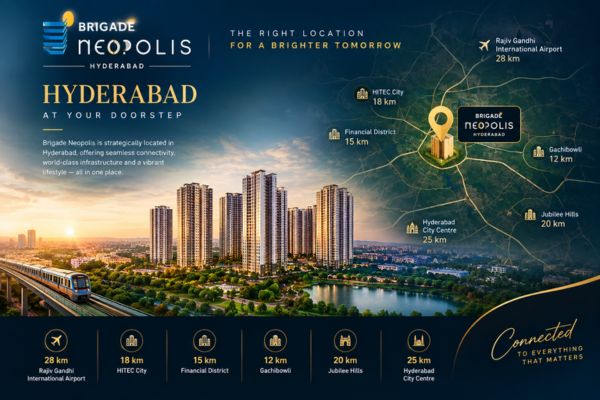
Hyderabad has transformed dramatically over the past five decades. What was once a laid-back nawabi city has become a vibrant urban sprawl hosting IT towers, Global Capability Centres, and ambitious real estate projects. For buyers looking at Brigade Neopolis Hyderabad, understanding the city's transformation explains why West Hyderabad has become the address that matters most for premium homebuyers.
Hyderabad's Transformation: From Nawabi City to Global Hub
Hyderabad's journey from a sleepy capital to a global technology destination is remarkable. The seventh Nizam, Mir Osman Ali Khan, gave the city a head start with good water supply, sewerage systems, road networks, and public utilities. But the real transformation began in the 1990s when the Software Technology Parks scheme launched in June 1991.
The Madhapur STP became the kernel that grew into Hyderabad's growth story. Today, the western side of the city features skyscrapers along wide roads, lending Hyderabad an international look that surprises even old residents returning after years abroad.
Here is how Hyderabad has changed over the decades:
- 1970s to 1980s: Central public sector undertakings like BHEL and MIDHANI, science laboratories, and defence establishments served as a springboard for future development.
- 1991: Software Technology Parks scheme launched, beginning Hyderabad's IT revolution from the Maitrivanam complex in Ameerpet.
- 2000s to 2010s: HITEC City and Gachibowli emerged as major IT employment hubs, drawing talent from across India.
- 2021 onwards: Global Capability Centre wave reshaped the office market, concentrating around the Financial District and Kokapet SEZ.
Why Hyderabad Is Called India's IT Hub
Hyderabad earned its reputation as a technology powerhouse through deliberate policy and infrastructure investment. Today, the city is home to over 370 Global Capability Centres, including a thriving cluster of more than 100 midmarket centres.
The city accounts for nearly 13% of India's digital talent, the fastest year-on-year growth across any metro. A staggering 55% of Hyderabad's GCC workforce is concentrated in high-value verticals like software and internet, BFSI, and semiconductors.
Major global companies have their largest facilities outside the US in Hyderabad. Microsoft, Apple, Google, Amazon, and Meta all have significant campuses here. Recent additions include Vanguard, McDonald's, and Amgen, which chose Hyderabad for their GCCs.
| IT Sector Metric | Data |
|---|---|
| IT professionals employed | Over 700,000 |
| Global Capability Centres | 370+ |
| Share of India's digital talent | Approximately 13% |
| GCC workforce in high-value verticals | 55% |
Infrastructure: The Backbone of Hyderabad's Growth
Infrastructure has played a defining role in Hyderabad's expansion. The Outer Ring Road (ORR) is particularly important, described by industry experts as a "very big asset" for the city.
The 158 km ORR connects seven state and national highways. It links the airport with different parts of the city and supports development along its route. This access-controlled expressway allows residents to travel from areas like Kokapet to the airport or HITEC City without entering congested city roads.
Hyderabad's metro network currently carries approximately 400,000 passengers daily across a 69.2 km network. The city's metro rail network is set to expand to 190 km by 2030, aiming to reduce commute times by up to 40%.
Other key infrastructure assets include:
- Rajiv Gandhi International Airport: Ranked among the world's most efficient airports, enhancing the city's accessibility for global investors and travelers.
- Regional Ring Road: Planned expansion to improve connectivity across the metropolitan region.
- Trumpet Interchange: Provides direct access from Kokapet and Neopolis to the ORR main carriageway.
Hyderabad's Real Estate Market in 2026
Hyderabad's residential market has entered a phase of more balanced growth in 2026. New launches fell sharply by 87% to 1,170 units in Q2 2026, while demand declined only 7% and prices rose 9%. This divergence suggests developers are being more deliberate about launch timing rather than cautious about the market itself.
West Hyderabad continues to dominate new supply, accounting for 72.5% of Q2 new supply. The concentration indicates that development remains heavily anchored in the western corridor despite the emergence of alternative growth locations.
Premium housing continues to drive transaction value. Homes priced above Rs 1 crore accounted for almost 15% of registrations but contributed 44% of transaction value in January 2026. This shows that demand for premium housing remains strong even as the market shifts toward more sustainable growth.
| Market Indicator | 2026 Data |
|---|---|
| West Hyderabad share of new supply | 72.5% |
| Price appreciation | 9% |
| Premium homes above Rs 1 crore share of value | 44% |
| Demand for 1BHK and 2BHK homes | 43% (but only 5% of new supply) |
Why West Hyderabad Leads the Real Estate Market
The western corridor, running from Gachibowli and the Financial District through Kokapet and Neopolis into Narsingi and Puppalguda, continues to attract the most considered, best-capitalised demand in the market.
The sales numbers tell the story. Kokapet recorded Rs 1,464 crore in gross sales in Q1 2025, the highest of any micro-market in Hyderabad. Narsingi came in at Rs 1,304 crore, and Puppalguda added Rs 706 crore. The West Zone altogether was Rs 8,937 crore across 11,215 units.
The foundation of this preference is employment. The Global Capability Centre wave concentrated around the Financial District, Nanakramguda, and the Kokapet SEZ cluster. Those office campuses house some of the most senior, internationally mobile, and financially capable employee cohorts in the country.
According to a five-year outlook, the western corridor's tech cluster is expected to add between 120,000 and 140,000 new jobs between 2026 and 2030 as GCC expansion continues. This employment growth has direct consequences for residential demand in the corridor.
Hyderabad vs Bangalore: How the Cities Compare
Hyderabad and Bangalore are often compared as India's leading technology hubs. While Bangalore had a head start, Hyderabad has been catching up rapidly with superior infrastructure and quality of living.
| Factor | Hyderabad | Bangalore |
|---|---|---|
| Commercial rent | About $1 per sq ft | Higher, pushing companies to explore alternatives |
| Residential price appreciation | 6-7% annually | 15-20% in tech corridors |
| Living space per person | 12-15 square meters | Tighter density |
| Traffic congestion | Less severe, ORR provides relief | Significant challenge |
| Liveability ranking | India's most liveable city for 7 consecutive years | Lower ranking |
Hyderabad's lower commercial rents and better infrastructure have attracted companies looking to escape Bangalore's congestion and high costs. The city's balanced growth and quality of life continue to draw both businesses and residents.
NRI Investment in Hyderabad Real Estate
Hyderabad is strengthening its position as a preferred destination for NRI property investment. The city's improving urban infrastructure, expanding business districts, and growing rental demand are key factors influencing buying decisions.
NRI real estate investments in India grew by 35% in FY24 and are projected to reach USD 14 billion by 2025. Hyderabad remains a preferred destination due to capital appreciation potential, lifestyle factors, and business-friendly policies.
Investment interest is concentrated in micro-markets benefiting from metro connectivity, commercial expansion, and proximity to major employment centres. The Financial District, Gachibowli, HITEC City, and Kokapet continue to attract attention.
Areas in the Financial District including Kokapet, Tellapur, and Gachibowli have experienced 8-12% annual price appreciation, reinforcing confidence in both commercial and residential segments.
Hyderabad's Future Outlook
The future outlook for Hyderabad is strong but measured. The city is moving from rapid expansion to more balanced, sustainable growth. The western corridor's tech cluster is expected to add 120,000 to 140,000 new jobs between 2026 and 2030.
Infrastructure projects will play a critical role. The metro network expansion to 190 km by 2030 aims to reduce commute times significantly. However, Metro Phase II proposals covering over 100 km remain pending approval, with uncertainty over timelines.
Hyderabad's economic diversity across IT, pharmaceuticals, manufacturing, and traditional industries provides stability. The city's commercial vacancy rate remains stable around 15%, indicating balanced absorption aligned with consistent economic activity.
As Hyderabad shapes its future, its unique blend of culture and urbanization offers a model for cities aiming to grow without the strain of hyper-competition or infrastructural overload.
Frequently Asked Questions About Hyderabad
-
What is Hyderabad known for?
Hyderabad is known as a major IT hub and home to Global Capability Centres for companies like Microsoft, Google, Amazon, and Apple. The city is also famous for its historic Charminar, biryani, and its blend of traditional culture with modern infrastructure. It has been ranked as India's most liveable city for seven consecutive years.
-
Why is Hyderabad called an IT hub?
Hyderabad earned its IT hub status after the Software Technology Parks scheme launched in 1991. The Madhapur STP became the kernel for the city's tech growth. Today, Hyderabad is home to over 370 Global Capability Centres and employs more than 700,000 IT professionals. Major global companies have their largest campuses outside the US here.
-
What is the population of Hyderabad?
Hyderabad's metropolitan population has crossed 10 million. The city is growing at an annual rate of about 2.8%, which is faster than Bangalore's 2.4% growth rate. This steady population increase supports continued demand for housing and commercial real estate.
-
Why is West Hyderabad the most popular area for real estate?
West Hyderabad is popular because it is close to the Financial District, Gachibowli, and HITEC City. These areas concentrate IT companies and GCCs that employ hundreds of thousands of professionals. The region has developed social infrastructure including schools, hospitals, malls, and restaurants, making it a complete live-work ecosystem.
-
What is the Outer Ring Road and why is it important?
The Outer Ring Road (ORR) is a 158 km access-controlled expressway that connects Hyderabad's airport to major employment hubs. It links seven state and national highways. The ORR is described as a 'very big asset' for the city because it allows fast travel without entering congested city roads, supporting development along its route.
-
How has Hyderabad's real estate market performed in 2026?
Hyderabad's real estate market has seen a moderation in new launches in 2026, with new supply falling sharply while demand declined only slightly. Property prices rose about 9%. West Hyderabad continues to dominate supply, accounting for over 72% of new launches. The market is shifting toward balanced growth after a strong premium-led period.
-
Why are NRIs investing in Hyderabad real estate?
NRIs are investing in Hyderabad because of the city's expanding technology ecosystem, strong office absorption, and rental demand. Areas like the Financial District, Kokapet, and Gachibowli see 8-12% annual price appreciation. Favorable exchange rates also improve purchasing power for overseas buyers earning in dollars or Gulf currencies.
-
What are the upcoming infrastructure projects in Hyderabad?
Hyderabad's Metro network is planned to expand to 190 km by 2030. Metro Phase II proposals covering over 100 km are pending approval. A Mass Rapid Transit System has been proposed for the Kokapet area. The Regional Ring Road and airport metro line from Gachibowli are also under discussion. These projects aim to reduce commute times.
-
How does Hyderabad compare to Bangalore for real estate?
Hyderabad offers lower commercial rents at around $1 per square foot compared to Bangalore, attracting GCCs. Residential prices appreciated at a moderate 6-7% annually versus Bangalore's 15-20% in tech corridors. Hyderabad also offers more generous living spaces, with 12-15 square meters per person versus Bangalore's tighter density. Traffic congestion is less severe.
-
What is the future outlook for Hyderabad real estate?
The future outlook is strong but measured. The western corridor's tech cluster is expected to add 120,000 to 140,000 new jobs between 2026 and 2030. This employment growth will support housing demand. The market is shifting from rapid expansion to more balanced, sustainable growth, with premium housing continuing to drive transaction value.